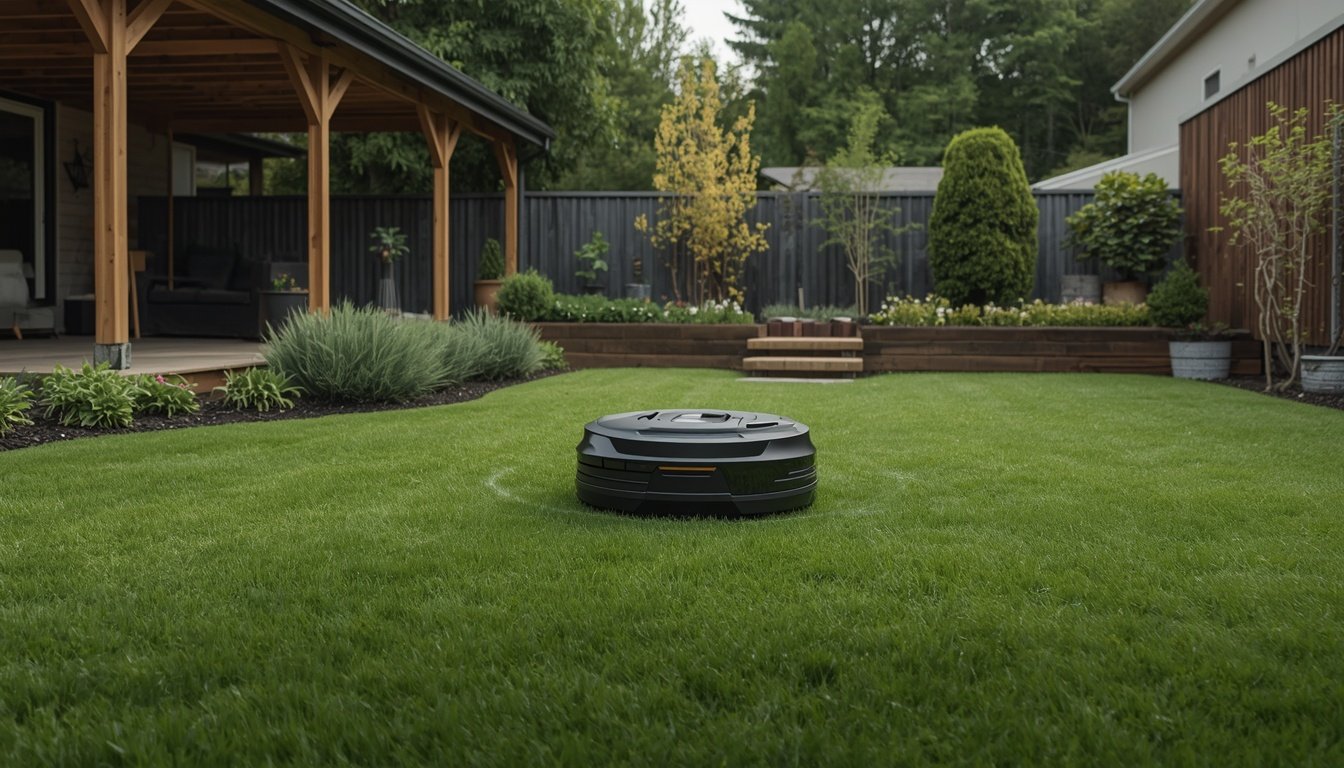
RTK robot mowers do not work reliably under dense tree canopies. Trees block the satellite signals and disrupt the accuracy of RTK navigation. As a result, mowing under trees may become inconsistent or lead to areas being missed entirely.
Why RTK Mowers Struggle Under Trees
RTK stands for Real-Time Kinematic satellite navigation. This technology depends on receiving strong signals from multiple satellites as well as a local base station for precise positioning. Trees, especially with thick or layered foliage, physically block these signals, causing interruptions or a complete loss of satellite data.
This signal interference leads to reduced accuracy. A mower might lose fix on its location while passing beneath tree branches. Even brief interruptions can cause the mower to stop, miss patches, or navigate incorrectly—potentially leaving unmowed spots or wandering off course.
Though some manufacturers claim their models handle partial shade or light tree cover, even small gaps in signal can be problematic. The more dense and widespread the tree canopy, the poorer the RTK performance will be. Open areas remain the recommended environment for best results with RTK-only navigation.
For lawns with significant tree coverage, consider models that blend RTK with secondary sensors or choose a mower designed specifically for such challenges.
Current Workarounds and Limitations
Some RTK mowers try to cope with tree obstacles by combining additional guidance systems. For example, certain models may use inertial sensors, on-board cameras, or ultrasonic sensors to supplement satellite navigation. This enables them to keep moving for a short time during temporary GPS loss.
However, these workarounds have limits. Inertial sensors help the mower “guess” its path while signals are weak, but errors accumulate quickly. Prolonged or repeated outages beneath dense trees still result in poor mowing coverage. Onboard cameras can help detect obstacles but don’t help with precise positional accuracy.
Mowers with hybrid navigation—like those combining RTK with LiDAR or boundary sensors—offer better reliability, but even these systems can struggle in areas where both visual and satellite cues are blocked by heavy foliage. For a list of models that perform better in wooded environments, see this guide on the best robot mowers for lawns with trees.
No fully wire-free solution currently exists that is entirely immune to dense tree coverage. For challenging lawns, traditional wired solutions are still the most foolproof option.
Tips for Managing RTK Mowers Near Trees
- Prune back low or dense branches to increase line-of-sight for satellite signals.
- Consider a hybrid navigation mower if your yard has significant tree cover.
- Program exclusion zones under dense trees where RTK may not work reliably.
- Monitor mowing patterns to spot and correct missed areas after initial runs.
These steps help improve the effectiveness of RTK robot mowers in partially tree-covered spaces. By increasing light and reducing shade, signal interruptions can decrease. Hybrid mowers, though still imperfect, deliver better results than RTK-only models in mixed environments. Monitoring the mower’s behavior and making adjustments as needed are essential for lawns where trees cover large portions of the mowing zone.