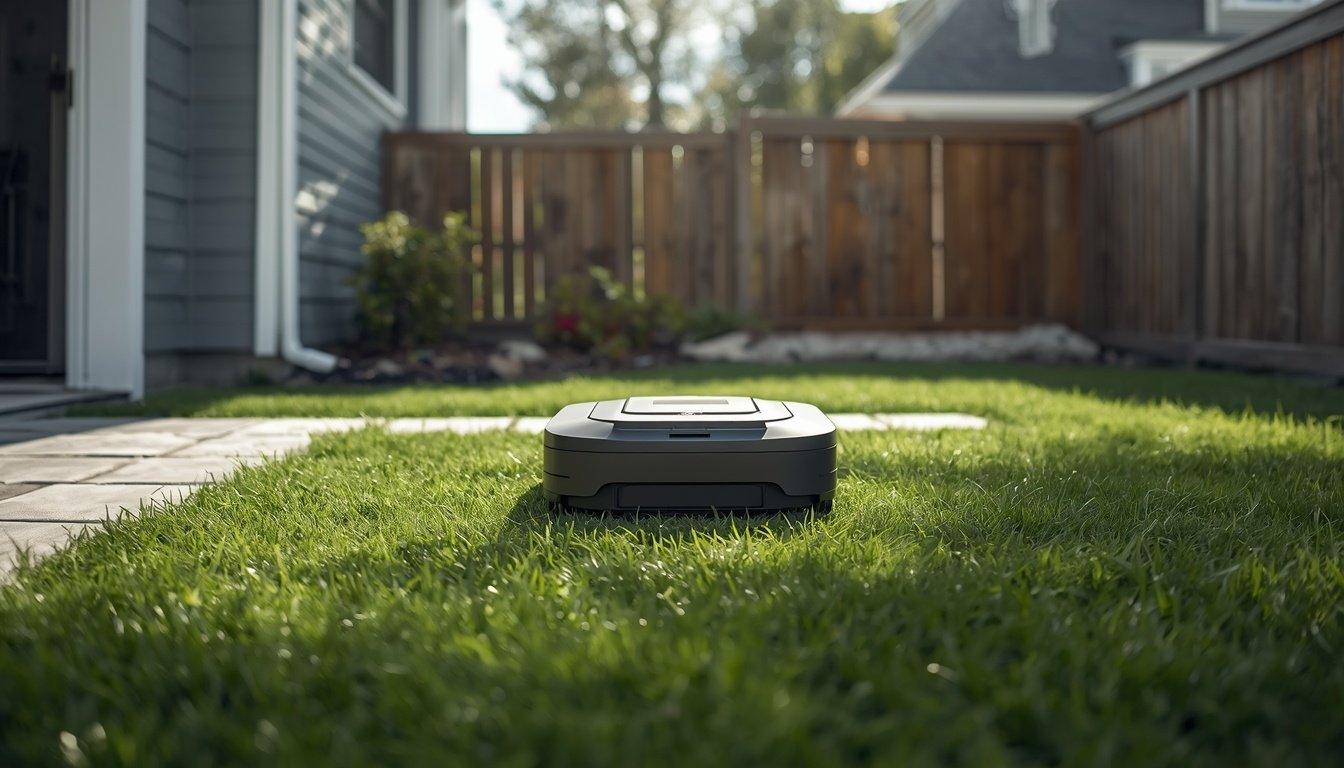
If your yard is split into multiple separated lawn areas, you’ll often need to carry your robot mower between these zones. Most wire-free robot mowers cannot autonomously cross obstacles or travel over uncut territory like driveways or walkways. Unless your mower and yard setup specifically support linked zones or paths, manual relocation is required to ensure the mower can cover each section.
When Carrying the Mower Is Necessary
Wire-free robot mowers rely on GPS, sensors, and mapping to stay within their assigned mowing zones. If your lawn spaces are divided by barriers such as fences, buildings, pavements, or uncut ground, the mower has no way to drive itself from one area to another. In these cases, the only practical solution is to physically pick up the mower and move it to the next lawn area.
This is common for homeowners with completely separate front and back lawns, or when there is no direct grass path connecting zones. Carrying is also required if your mower’s software doesn’t support multi-zone programming or if Wi-Fi and GPS signals don’t stretch reliably between areas. For most standard wire-free models, moving the device between unlinked zones is a normal part of routine use.
Manual relocation is particularly necessary for entry-level and mid-range mowers, which rarely include multi-zone support or advanced navigation that recognizes separate sections automatically. Always check your model’s capabilities before purchase.
Features That Help With Multi-Area Lawns
- Multi-zone programming allows setup of distinct zones within the app interface.
- Automatic path navigation can guide some models across driveways or walkways.
- Portable charging stations make carrying and relocating the base simpler for remote lawns.
- Some premium models support mapping multiple zones with virtual boundaries.
- Push notifications may remind you to move the mower between areas when needed.
Mowers equipped with multi-zone support are much more convenient for complex yards. With the right features, you can tell your mower to mow different areas in sequence and it will know where it is within your property. In some advanced models, you won’t need to constantly intervene, as the mower is able to maneuver between assigned zones if clear, safe paths exist. If these features are important for your lawn layout, consider researching multi-zone wire-free robot mowers to find a model that fits your needs. Feature sets vary, so always check compatibility with your yard design.
Tips for Managing Separate Lawn Areas
To make handling separate lawn zones easier, plan your mowing routine according to how your spaces are divided. If you must move the mower manually, select a lightweight model that’s simple to lift and easy to transport. Some robot mowers offer built-in handles or compact shapes that help with this task.
Always set clear virtual boundaries for each area and double-check the GPS accuracy each time you relocate the unit. Be aware that different lawns may have varying signal quality, so position your charging station where coverage is best. Charging base relocation can be necessary if some zones are far apart.
If you find carrying the mower inconvenient, look into lawn modifications such as adding a narrow grass path between zones or reducing hardscape barriers. Alternatively, upgrading to a mower with enhanced multi-zone capability may minimize manual intervention while maximizing mowing coverage for complex properties.