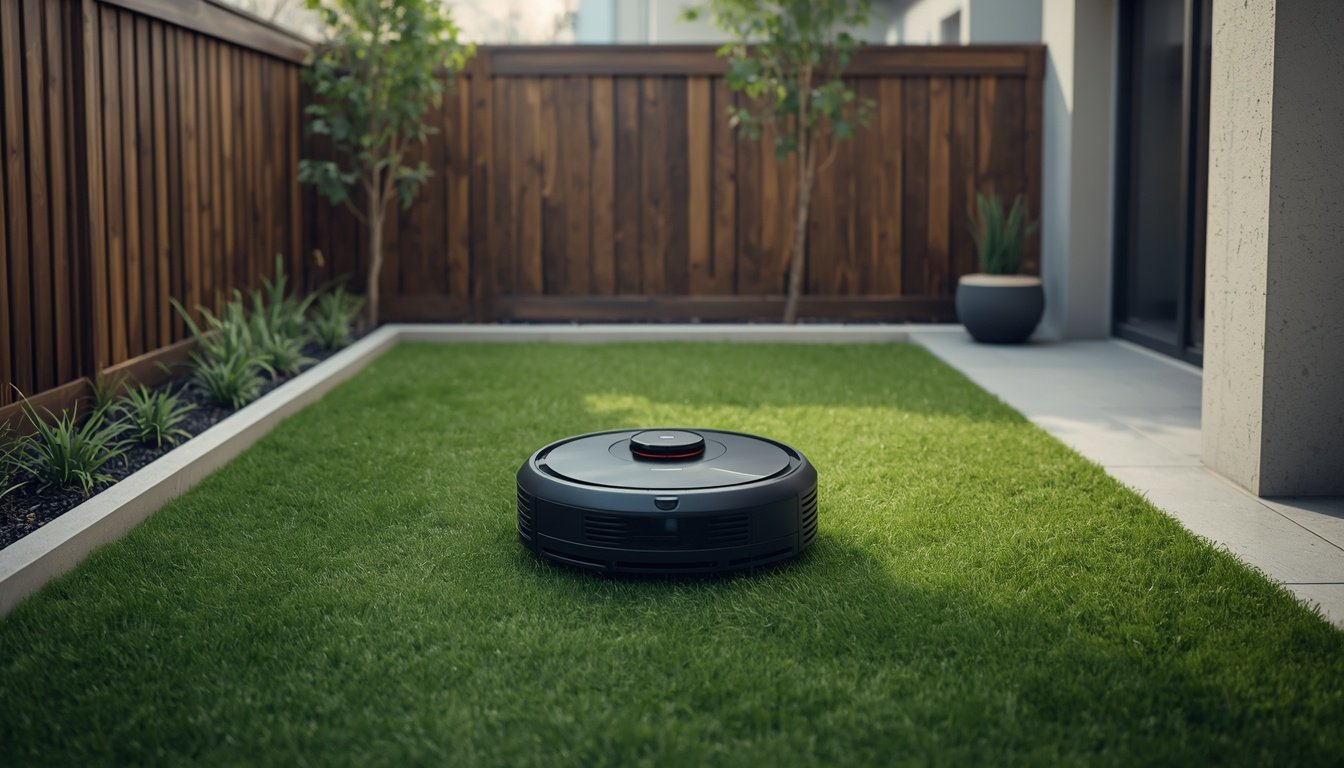
RTK, or Real-Time Kinematic, is a satellite-based positioning technology used in some modern robot lawn mowers to improve navigation accuracy. RTK enables robot mowers to position themselves and follow mowing paths within a few centimeters, far more precisely than standard GPS. This allows wire-free boundary operation, meaning the mower does not need a buried perimeter wire to stay within its designated area.
How It Works
RTK works by using signals from GNSS (global navigation satellite systems) like GPS, combined with correction data, to achieve highly accurate positioning. An RTK-enabled robot mower typically receives real-time correction signals from a fixed base station or a network source. This reduces errors caused by satellite drift, atmospheric conditions, and other factors.
The robot mower processes both the satellite data and the correction signals to calculate its position on the lawn. By constantly updating this information, the mower can travel in straight lines, navigate complex shapes, and avoid straying outside the defined area, even without perimeter wires. The system’s effectiveness depends on reliable reception of both satellite and correction signals in the mowing area.
What It Can Do
RTK technology gives robot mowers new capabilities that are not possible with traditional random navigation or basic GPS-only systems. These enhancements are especially useful for achieving efficient and precise mowing patterns.
- Guide the mower in straight, predictable lines for systematic coverage.
- Maintain its location to within a few centimeters, minimizing missed spots and overlaps.
- Operate without a boundary wire by relying on digital maps created during setup.
- Adapt to complex or irregular lawn shapes by following virtual boundaries set in software.
As a result, lawns can be mowed more efficiently, with less random movement and faster completion. RTK also allows for flexible changes to mowing zones, making setup and adjustments simpler for the user. For a deeper look at how these systems compare to other navigation options, see RTK and LiDAR robot mower navigation.
Limitations and What It Cannot Do
While RTK can greatly increase accuracy, it has clear limitations and conditions that affect its performance. Understanding these constraints is essential for users considering RTK-based mowers or troubleshooting performance issues.
- Needs a direct line of sight to satellites and the base station; trees, buildings, or tall objects can block signals.
- May lose accuracy or function in dense shade, under thick tree canopies, or near large obstacles.
- Requires setup of a base station or subscription to an RTK correction service, adding complexity.
- Cannot function if satellite signals or correction data are interrupted or unreliable.
RTK is not immune to environmental interference. If part of the yard is under heavy tree cover, the mower may revert to less accurate navigation or stop working in that zone. Setup can also be more technical compared to simple wire-based mowers, and maintaining a clear signal path is crucial for reliability. RTK does not eliminate all navigation issues, and performance can still vary based on local conditions.
When It Works Best
Robot mowers with RTK perform best in open areas with a good view of the sky. Large, unobstructed lawns with few trees or tall structures are ideal environments. RTK systems also suit properties with complex boundaries where laying wire would be difficult, or areas where frequent layout changes are needed.
Residential yards, sports fields, and commercial lawns in open settings are typical scenarios for successful RTK operation. In such areas, the mower can consistently receive satellite and correction signals, resulting in efficient and reliable mowing. For lawns with substantial overhead obstruction or highly variable terrain, RTK may not deliver its full benefits.
Common Misconceptions
Some users believe RTK allows robot mowers to work flawlessly in any conditions, even indoors or entirely under trees. However, RTK cannot overcome heavy signal blockage. Another misconception is that RTK mowers always outperform wire-guided versions; in some terrain, a traditional wire may provide more consistent operation. RTK also does not mean a mower is fully autonomous in all weather or obstructions.
Final Answer Summary
RTK is a satellite correction technology used in wire-free robot mowers for precise, boundary-free navigation. It delivers reliable results in open, unobstructed lawns but has clear limitations when signals are blocked. Choosing RTK depends on whether your mowing area matches the requirements for consistent satellite and correction signal reception.