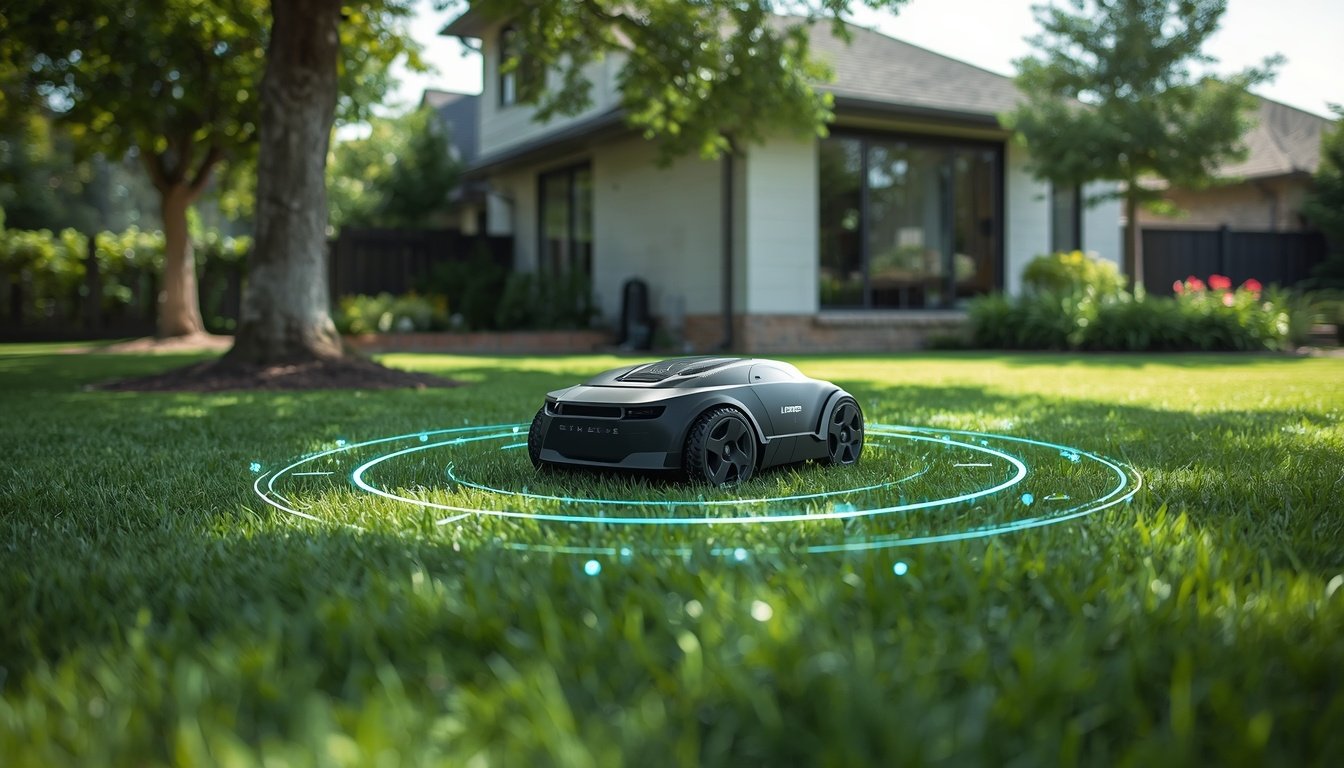
RTK and LiDAR are two of the main technologies that allow modern robot lawn mowers to work without a buried boundary wire. RTK helps a mower understand its exact outdoor position, while LiDAR helps it read the physical environment around it, including trees, edges, objects, and layout changes.
For homeowners, the key point is that these technologies solve different problems. RTK is mainly about location accuracy across the lawn, while LiDAR is mainly about sensing and mapping the mower’s surroundings. Some mowers use one system, while more advanced models may combine RTK, LiDAR, cameras, GPS, app mapping, and obstacle sensors to create a more reliable wire-free mowing system.
What This Guide Covers
This guide explains how RTK and LiDAR work in robot lawn mowers, why they matter, where each technology is useful, and what limitations homeowners should understand before buying. It is designed to help you compare navigation systems without getting lost in technical language.
If you are completely new to the category, it may help to first read How Do Wire-Free Robot Mowers Work?. That guide explains the basic idea of replacing a physical perimeter wire with mapping, positioning, sensors, and software.
This page focuses more specifically on the navigation side. By the end, you should understand why some robot mowers need an RTK base station, why some models use LiDAR, why tree cover can affect performance, and why the best option depends on your lawn rather than the technology name alone.
How Robot Mower Navigation Works
A wire-free robot mower needs to know three things: where it is, where the mowing boundary is, and what objects it should avoid. Older robotic mowers solved the boundary problem by following a buried wire. Newer models try to solve it through digital mapping and real-time navigation.
RTK stands for real-time kinematic positioning. In simple terms, it is a more accurate form of satellite-based positioning than basic GPS. An RTK mower usually compares satellite location data with information from a nearby reference station or base station. This helps the mower understand its position more precisely than it could with ordinary GPS alone.
LiDAR works differently. It uses light-based scanning to measure distances and detect shapes around the mower. Instead of depending only on satellite position, a LiDAR-equipped mower can scan nearby objects, lawn edges, trees, walls, paths, and obstacles. This can help the mower build or support a map of the working area.
That difference matters. RTK is useful for keeping the mower accurately positioned across an open outdoor space. LiDAR is useful for understanding what is physically around the mower. For a simple explanation of RTK on its own, see What Is RTK on a Robot Lawn Mower?. For a dedicated explanation of LiDAR, see What Is LiDAR on a Robot Lawn Mower?.
Common Use Cases
RTK is especially useful on open lawns where the mower can maintain a clear view of the sky. It can help with accurate boundaries, planned mowing routes, multi-zone mapping, and efficient coverage. If your lawn is open, fairly clear, and not heavily shaded by trees or buildings, an RTK-based system may work very well.
LiDAR is especially useful when the lawn has more physical complexity. This can include trees, garden beds, edges, walls, ornaments, paths, and changing obstacles. Because LiDAR reads the nearby environment, it can help the mower understand its surroundings even when the lawn is not a simple open rectangle.
Hybrid systems are often attractive for complex properties. A mower that combines RTK positioning with LiDAR, camera vision, and obstacle detection may be better suited to lawns with slopes, trees, narrow passages, and separate mowing zones. If your lawn has several difficult features, Best Robot Mower Navigation System for Complex Lawns is a useful next guide.
RTK and LiDAR also matter during setup. Some RTK mowers need a base station placed in a strong signal location, while some LiDAR or camera-based mowers may rely more heavily on scanning and mapping. The setup process can affect long-term performance, so it is worth understanding the technology before choosing a model.
Key Factors to Consider
- Sky visibility: RTK systems usually perform best when the mower and base station have a clear view of the sky.
- Lawn complexity: LiDAR, camera vision, or hybrid systems may be more useful around trees, obstacles, paths, and garden edges.
- Base station needs: some RTK mowers require careful base station placement for reliable positioning.
- Obstacle detection: navigation accuracy is not the same as object avoidance, so check how the mower handles toys, pets, people, and garden items.
- Mapping process: some mowers require guided mapping, while others build or refine maps with sensors and software.
The mistake many buyers make is treating RTK and LiDAR as if one is always better than the other. That is not the right way to think about it. A flat, open lawn and a shaded, tree-filled lawn do not create the same navigation problem.
It is also important to separate navigation from cutting performance. A mower may have accurate mapping but still struggle with wet grass, steep slopes, rough ground, or poor blade maintenance. Navigation helps the mower know where to go, but traction, mower size, battery capacity, blade design, and software also affect real-world results.
Choosing the Right Option
Start by looking at your lawn layout. If the lawn is open, has good sky visibility, and needs accurate virtual boundaries, an RTK-focused mower may be a strong fit. If your lawn has many trees, obstacles, edges, and shaded areas, LiDAR or a hybrid navigation system may be more suitable.
If you are comparing the two technologies directly, read RTK vs LiDAR Robot Lawn Mowers. That comparison is better for buyers who already understand the basics and want practical guidance on which system suits their yard.
It is also worth comparing RTK with ordinary GPS. Basic GPS can be too broad for precise lawn boundaries, while RTK is designed to improve positioning accuracy. For that specific comparison, use RTK vs GPS Robot Lawn Mowers.
For homeowners considering LiDAR models, the next comparison is usually LiDAR versus camera navigation. Cameras can help a mower recognise objects and lawn features, but lighting, shadows, and software quality can affect performance. LiDAR can help measure distance and structure, but it still needs good software to turn that data into reliable mowing decisions.
The right choice is usually the mower that matches your lawn’s hardest problem. For some homes, that problem is accurate boundary mapping. For others, it is trees. For others, it is slopes, narrow passages, or obstacle avoidance.
Limitations and Considerations
RTK is powerful, but it is not magic. It can struggle when the mower or base station has poor sky visibility, heavy tree cover, nearby buildings, or weak satellite conditions. This does not mean RTK is bad, but it does mean placement and lawn conditions matter.
LiDAR is also not perfect. It can help the mower sense its surroundings, but it does not automatically guarantee flawless mowing. Sensor quality, cleaning, software, object size, lighting, and the shape of the lawn can all affect results. A mower may detect large obstacles well but still miss very small items on the grass.
Base station placement is one of the most important practical issues for RTK systems. If the base station is poorly positioned, the mower may experience weak location accuracy or connection problems. Before buying an RTK mower, read Do You Need a Base Station for an RTK Robot Mower? and What Happens If a Robot Mower Loses GPS or RTK Signal?.
Tree cover deserves special attention. Some homeowners assume a wire-free mower will work anywhere because there is no boundary cable to install, but trees can still affect navigation depending on the system used. If your lawn has heavy shade or large tree canopies, read Do RTK Robot Mowers Work Under Trees? before choosing a model.