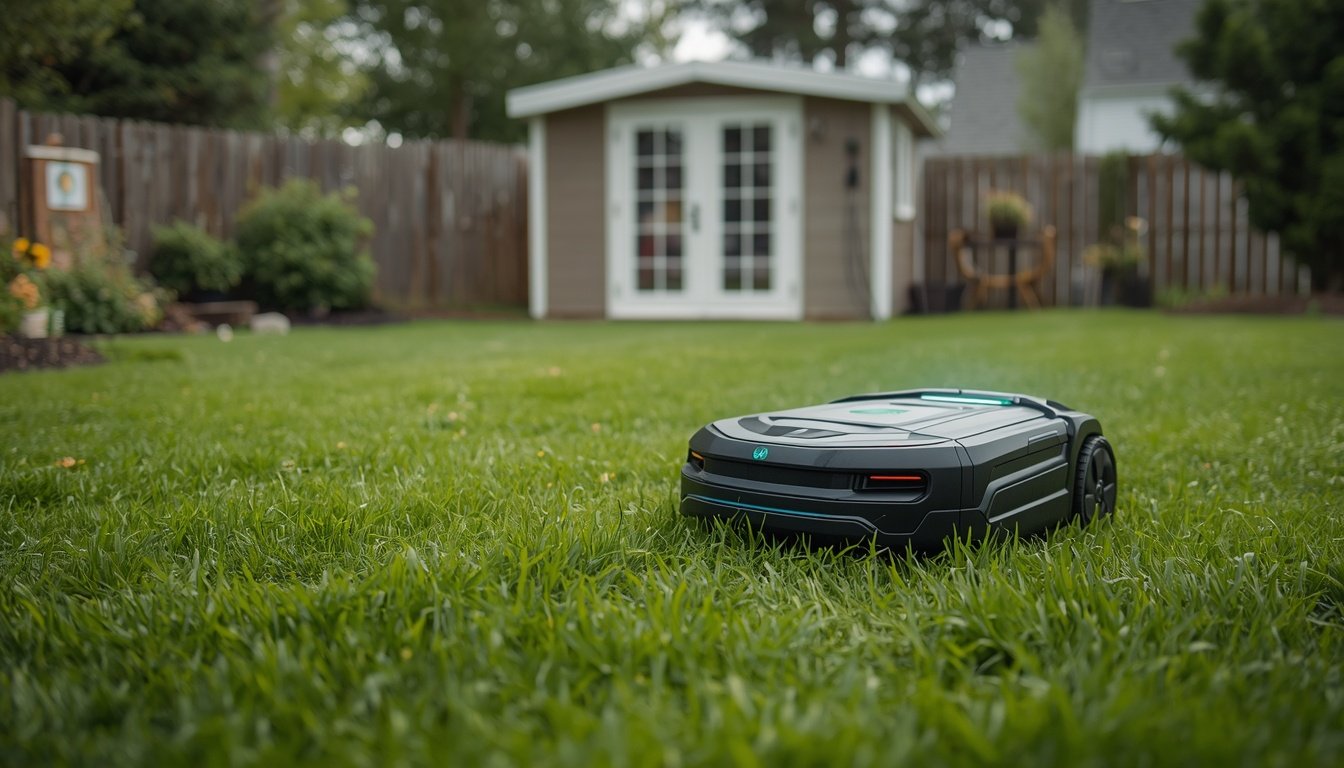
Virtual boundaries on wire-free robot lawn mowers work by using GPS, onboard sensors, or mapping technology to define and remember the edges of your lawn digitally, rather than relying on a physical boundary wire. The mower receives instructions—either set up via a smartphone app or during an initial mapping run—to recognize and avoid areas outside the programmed perimeter. This allows the robot to operate within a set area while avoiding garden beds, driveways, and other obstacles.
How It Works
Instead of physical wires buried around the lawn, wire-free robot mowers use advanced systems to define mowing zones. During setup, users often guide the mower along the desired perimeter with their mobile device or remote. The mower records GPS coordinates or creates a digital map using onboard sensors, such as cameras, inertial measurement units, or satellite data. This virtual map is stored in the mower’s memory, and the mower thereafter relies on its location data to detect when it’s approaching the edge of the mapped area.
If the mower nears a virtual boundary, its internal logic triggers a turn or stop, keeping it within the assigned space. Most models also allow users to update, adjust, or set “no-go” areas as needed.
What It Can Do
Wire-free robot mowers using virtual boundaries offer several practical features for homeowners who want automated lawn care without installing physical wires. These capabilities provide flexibility in setup and daily usage.
- Create customizable mowing areas without digging or laying wire
- Support for complex lawn shapes and multiple areas/zones
- Allow creation of temporary or permanent exclusion zones
- Automated navigation with obstacle avoidance
With these features, users can adapt the mowing area to seasonal changes or landscaping updates quickly. It is also simpler to revise boundaries if you add flower beds, patios, or other features to your yard. The ability to handle more complex shapes and dynamic zones gives wire-free systems more flexibility compared to traditional wired setups.
Limitations and What It Cannot Do
Despite their advantages, virtual boundaries have important limitations and are not suited for every application. Awareness of these constraints ensures realistic expectations and effective installation.
- Reduced accuracy if GPS signal is weak or obstructed by trees or tall buildings
- May struggle with very small or irregularly-shaped lawns
- Cannot provide precise edges in environments with poor sensor visibility
- Potential for drift or boundary errors in unstable weather or after hardware calibration issues
- Dependence on software updates and digital maps to maintain zones
It is important to note that wire-free robot mowers may occasionally exit set boundaries if their location tracking is disrupted. Satellite limitations or interference can temporarily affect performance. Manual intervention or remapping may be required in such cases. Users should also be aware that setup requires careful initial mapping and regular verification of the defined zones to keep operation consistent and safe.
When It Works Best
Virtual boundary systems work best in open lawns with minimal tall structures, dense trees, or sources of signal interference. They perform especially well on medium to large properties where laying wire would be labor-intensive. They are also suitable for homeowners who frequently change their landscaping or want to modify mow zones without extra effort.
These systems tend to be less effective in dense urban environments, in gardens with heavy tree canopies, or on properties with poor satellite visibility. Ideal candidates have a clear outdoor space, stable Wi-Fi or GPS connections, and value easy reconfiguration.
Common Misconceptions
Some users believe that wire-free robot mowers are always more precise than wire-based models, but this depends on signal quality and lawn complexity. Another misconception is that these systems can work perfectly in any yard; in reality, their performance depends strongly on good mapping and location data. Additionally, the absence of wires does not mean the mower will automatically recognize every obstacle, so manual setup is still critical.
Final Answer Summary
Virtual boundaries on robot lawn mowers use GPS, mapping, or sensor technology to keep the mower within a predefined digital area without any physical wires. While flexible and convenient, they require careful setup and are limited by environmental factors such as signal quality and mapping accuracy. For more details about traditional and wire-free setups, see this guide on boundary wire vs wire-free robot mowers.