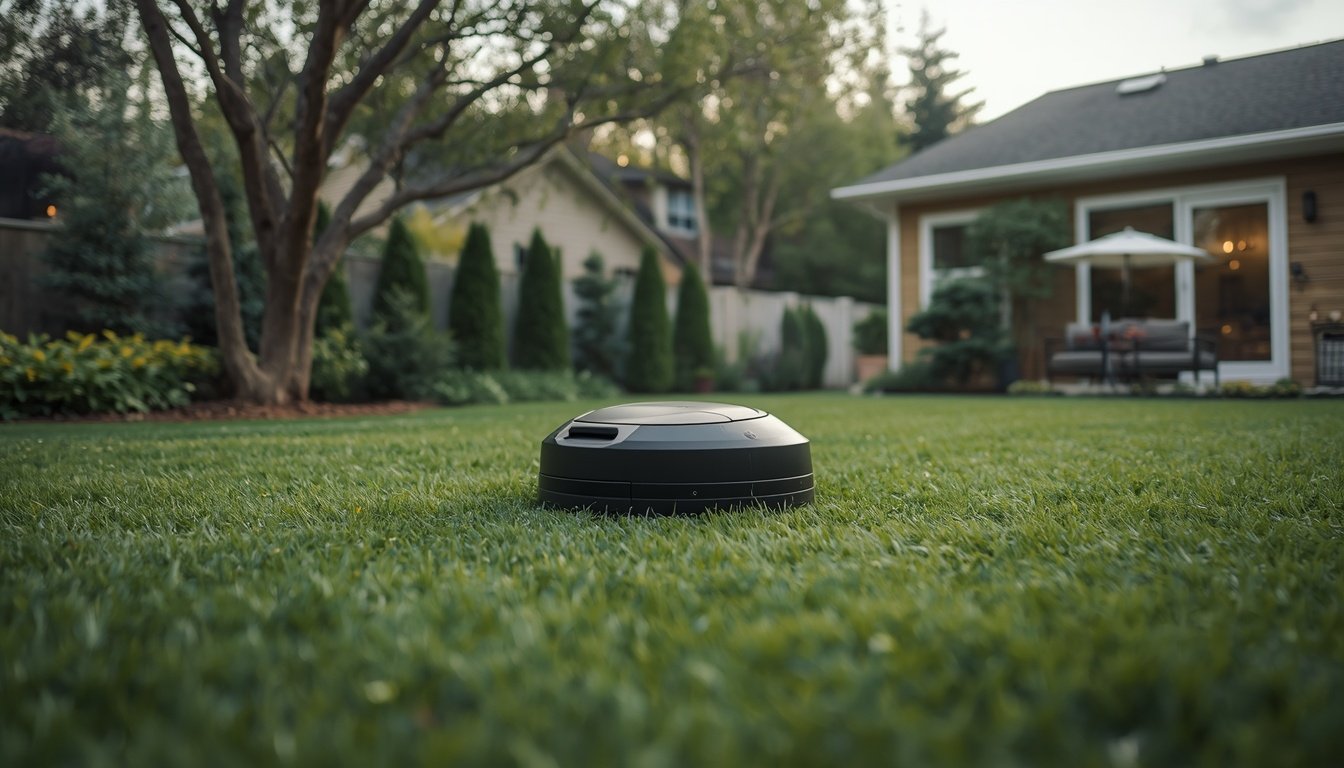
Segway Navimow i215 LiDAR Review
A spec-based review of the Segway Navimow i215 LiDAR for buyers who want a wire-free robot mower with LiDAR-assisted sensing.
The Segway Navimow i215 LiDAR is a wire-free robotic lawn mower aimed at homeowners who want smarter navigation around trees, garden edges, obstacles, and more detailed lawn layouts. It is most relevant for buyers who like the Navimow i Series idea but want the extra sensing focus of a LiDAR-assisted model.
This mower is not the obvious choice for every lawn. It makes the most sense when your yard has trees, shaded areas, garden beds, lawn features, or obstacles where LiDAR and vision-based navigation may be more useful than a simpler wire-free mower.
This Segway Navimow i215 LiDAR review is based on official product specifications, listed product features, Amazon listing details, and buyer-focused analysis. It is not a hands-on test, so buyers should confirm current specifications, included accessories, warranty terms, app requirements, and product availability before purchasing.
Quick Verdict
Best use case: small to medium lawns where trees, garden features, obstacles, and smarter sensing matter.
Main advantage: the LiDAR + Vision positioning makes this model more relevant for obstacle-aware mowing than a basic compact wire-free mower.
Main limitation: LiDAR does not make the mower perfect, and it still needs suitable lawn conditions, clean sensors, accurate setup, and realistic expectations.

Segway Navimow i215 LiDAR
A LiDAR-assisted wire-free robot lawn mower for homeowners who want smarter mowing around trees, edges, and common lawn obstacles.
Product Overview and Key Specs
The Segway Navimow i215 LiDAR is part of Segway’s newer LiDAR-focused robot mower range. The key difference from simpler wire-free mowers is that this model is positioned around LiDAR and vision-based sensing rather than relying only on a basic positioning or app-mapping system.
In plain English, this is the Navimow model to consider when obstacle awareness and lawn-feature sensing are important. It is not the heavy-duty AWD choice for very rough or large properties, but it is a strong fit for buyers who want a smarter mower for a more detailed residential yard.
| Spec | Segway Navimow i215 LiDAR |
|---|---|
| Product type | Wire-free robotic lawn mower |
| Brand | Segway Navimow |
| Model | i215 LiDAR |
| Recommended mowing area | 1,500 m² class listed; approximately 0.37 acre class |
| Navigation / sensing | LiDAR + Vision dual system listed |
| Boundary wire | No buried perimeter wire required for normal wire-free setup |
| RTK antenna | No separate antenna listed for the i2 LiDAR direction |
| Obstacle detection | 200+ obstacle types listed with 1 cm precision; buyers should still clear risky objects before mowing |
| Slope capability | Up to 45% / 24° listed |
| Cutting height | 20–70 mm listed in retailer specifications; confirm current listing for your market |
| Best match | Lawns with trees, obstacles, garden edges, and more detailed layouts |
Who This Product Is Best For
Lawns with trees
The i215 LiDAR is most relevant when tree trunks, shaded areas, roots, edges, and nearby garden features make mowing less straightforward.
Obstacle-aware buyers
This model suits homeowners who want stronger sensing around objects, garden beds, lawn edges, and changing backyard conditions.
Wire-free mower upgraders
It is a good fit if you want to avoid boundary wire but still want a mower with more sensing capability than a basic compact option.
Medium residential lawns
The listed mowing area makes it more suitable for larger small-to-medium lawns than the smallest i Series options.
Design and Build Quality
The Segway Navimow i215 LiDAR has the modern low-profile look expected from a residential robotic lawn mower. The important design feature is not just the body shape, but the LiDAR-focused sensing system and wire-free setup approach.
Because this is a specification-based review, this article does not claim hands-on impressions of wheel feel, plastic quality, docking smoothness, or long-term durability. Buyers should confirm current product dimensions, included accessories, spare parts availability, warranty details, and local support before purchasing.
From a practical design-fit perspective, the main questions are whether the mower can move through your lawn layout, whether the charging station has a sensible location, and whether the mower’s sensors can stay clean and unobstructed during normal use.
Performance Expectations
The i215 LiDAR should be viewed as a sensing-focused wire-free mower for routine grass maintenance. It is designed for homeowners who want a mower that can understand more of the physical lawn environment than a basic open-lawn mower.
The LiDAR + Vision system is the main reason to choose this model. It is especially relevant for lawns with trees, garden beds, edges, and obstacles. However, buyers should not treat sensor technology as a guarantee that every small object, toy, twig, or low garden item will be handled perfectly every time.
Like other robot mowers, the i215 LiDAR is best for regular maintenance cuts. It should not be expected to rescue badly overgrown grass, remove heavy debris, fix uneven ground, or replace all trimming around walls, fences, raised borders, and tight corners.
Installation and Setup
The main setup appeal of the Segway Navimow i215 LiDAR is that it is designed for wire-free mowing without a buried perimeter cable. That can make setup cleaner than older boundary-wire systems, but the mower still needs planning before it can work reliably.
- Is your actual grass area within the mower’s listed mowing capacity?
- Where will the charging station sit, and can the mower enter and leave it easily?
- Does the lawn include trees, roots, garden beds, paths, or lawn ornaments?
- Are there fragile areas that should be set as no-go zones?
- Will fallen leaves, twigs, dog toys, or garden tools need clearing before mowing?
- Does the lawn have slopes close to the model’s listed maximum capability?
- Are the LiDAR and vision sensor areas easy to keep clean?
Professional installation is not clearly required from the supplied information, but careful setup is still important. The first few mowing sessions should be supervised so boundaries, zones, and problem areas can be adjusted before routine scheduling.
Pros and Cons
What Stands Out
- Wire-free mowing without buried perimeter cable
- LiDAR + Vision navigation listed
- Useful fit for lawns with trees and obstacles
- 1,500 m² class coverage listed
- 45% slope capability listed
- No separate RTK antenna listed for this LiDAR direction
What to Watch
- May be unnecessary for a simple open lawn
- Still needs setup, mapping, and charging station planning
- Sensor areas need to stay clean
- Small objects and debris may still need clearing
- Not the same as a heavy-duty AWD large-lawn mower
- Current specs and included accessories should be confirmed before buying
How It Compares to Other Options
The Segway Navimow i215 LiDAR is best compared with other wire-free mowers by use case. It is more sensor-focused than the smaller i105N and i110N, but it is not necessarily the right substitute for a large AWD mower designed around heavy terrain capability.
| Option | Best Fit | Main Trade-Off |
|---|---|---|
| Segway Navimow i215 LiDAR | Trees, obstacles, garden edges, and LiDAR-assisted mowing | May be more sensing than a simple open lawn needs |
| Segway Navimow i105N | Small lawns where compact wire-free mowing is enough | Less suitable where LiDAR-style sensing is the main priority |
| Segway Navimow i110N | Small-to-medium lawns where RTK-style wire-free mowing is the focus | Less focused on LiDAR-assisted sensing |
| Premium AWD wire-free mower | Large, sloped, uneven, or complex terrain-heavy lawns | Can be more mower than many residential lawns need |
Who Should Skip It
Skip the Segway Navimow i215 LiDAR if your lawn is very small, flat, open, and easy to mow. In that situation, a simpler compact wire-free mower may be more practical and easier to justify.
You should also pause if your main problem is heavy-duty terrain rather than obstacle sensing. Very rough ground, deep mud, steep wet slopes, exposed roots, large acreage, or difficult transitions may require a different mower category.
Buyers should also avoid assuming LiDAR removes all supervision. Sensor-based mowing still works best when the lawn is kept reasonably clear, the mower is set up carefully, and early runs are watched for missed areas or trouble spots.
Frequently Asked Questions
Does the Segway Navimow i215 LiDAR need boundary wire?
No buried perimeter wire is listed as required for normal wire-free setup. Buyers should still expect mapping, app setup, charging station placement, and possible no-go zone setup.
Does it need a separate RTK antenna?
The i2 LiDAR direction is listed as no antenna. Buyers should confirm the current product listing and included accessories before purchasing.
What size lawn is the i215 LiDAR for?
The i215 LiDAR is listed in the 1,500 m² class, which is roughly 0.37 acre. Buyers should compare this with the actual grass area, not the total property size.
Is LiDAR useful under trees?
LiDAR can be useful in tree-heavy yards because it helps the mower sense surrounding lawn features. Buyers should still watch for roots, fallen branches, leaves, and wet shaded grass.
Can it avoid every obstacle?
No robot mower should be treated as perfect around every object. The product page lists advanced obstacle detection, but buyers should still remove small toys, cords, tools, loose branches, and fragile objects before mowing.
Can it handle slopes?
The i215 LiDAR is listed with up to 45% slope capability. Buyers should compare this with the actual steepest areas of the lawn and consider wet grass, soft soil, and turning space.
Is this better than the i105N or i110N?
It is better only if the lawn needs what it offers. The i105N and i110N may be more practical for simpler lawns, while the i215 LiDAR makes more sense when LiDAR-assisted sensing is a real benefit.
Final Verdict
The Segway Navimow i215 LiDAR is best suited to homeowners who want a wire-free robot mower with stronger sensing around trees, garden edges, and obstacles. Its main reason to buy is the LiDAR + Vision navigation direction, especially for yards that are more detailed than a simple open rectangle.
The main reason to pause is that LiDAR is not automatically necessary for every lawn. If your yard is small, flat, open, and simple, a less expensive or simpler wire-free mower may be enough.
Bottom line: the i215 LiDAR is a strong fit when obstacle awareness and lawn-feature sensing matter, but buyers should still match it carefully to lawn size, slope, terrain, and setup conditions.
Segway Navimow i215 LiDAR
A LiDAR-assisted wire-free robot mower for buyers with trees, obstacles, garden features, and more detailed residential lawn layouts.