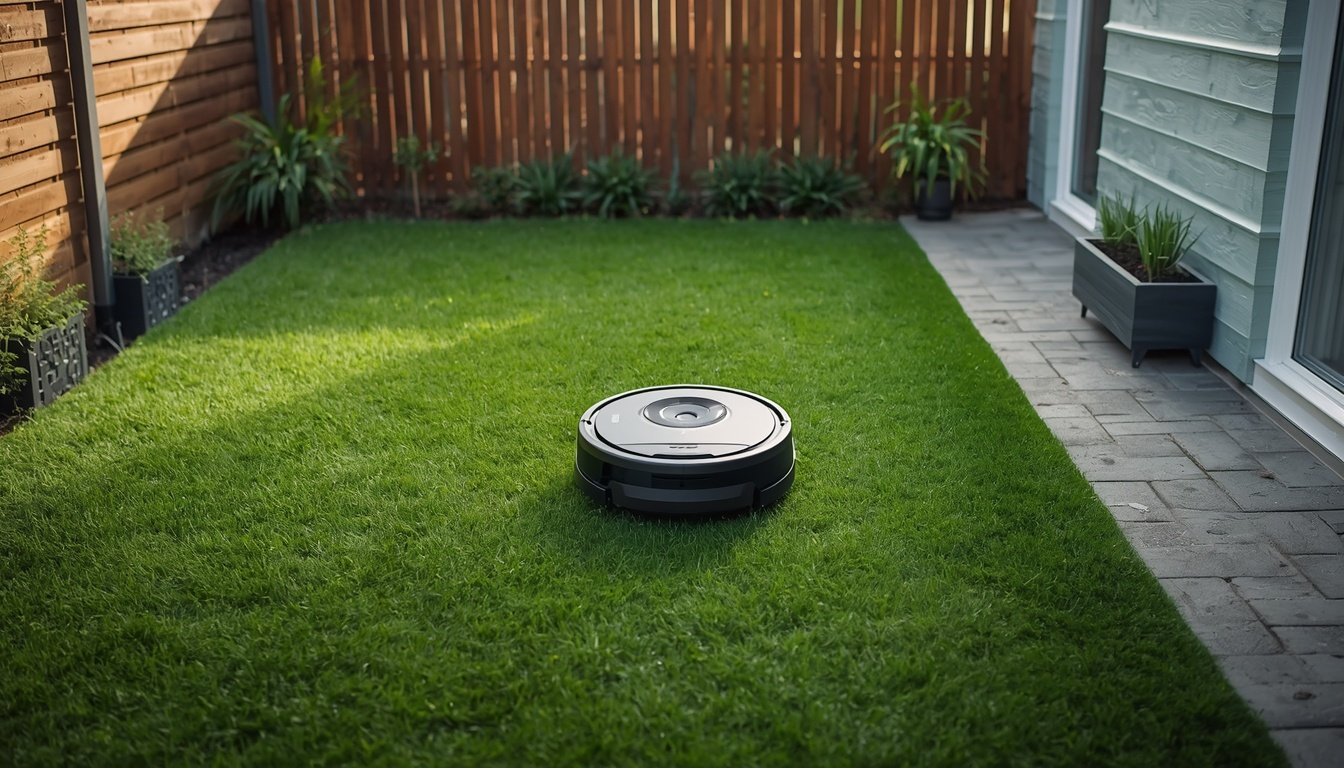
LiDAR on a robot lawn mower is a technology that uses laser sensors to measure distances and create a map of its surroundings. This system allows a mower to detect obstacles, follow virtual boundaries, and navigate a lawn without relying on physical boundary wires. LiDAR provides real-time, high-accuracy environmental sensing to help wire-free robot mowers operate safely and efficiently.
How It Works
LiDAR stands for Light Detection and Ranging. On a robot lawn mower, a LiDAR sensor emits rapid pulses of laser light and measures how long it takes for each pulse to reflect back from surfaces around the mower. The sensor rapidly collects distance data in all directions, creating a 3D point cloud that represents the environment. The mower’s onboard computer processes this data to identify lawns edges, detect obstacles, and plan mowing paths. LiDAR operates independently of lighting conditions, making it effective both day and night, as long as the sensor is not blocked.
What It Can Do
By integrating LiDAR, robot lawn mowers perform complex navigation tasks and respond dynamically to their environment. This improves the ability of the mower to operate without physical wires and adapt to changing outdoor conditions.
- Accurately sense and map the layout of the yard, including edges, walls, and garden features
- Detect and avoid static and moving obstacles such as garden furniture, trees, pets, or people
- Enable virtual boundary navigation, so the mower stays within defined areas without a perimeter wire
- Allow operation in various lighting conditions, since LiDAR does not rely on daylight or visible cues
These capabilities make LiDAR-based navigation practical for complex lawns and dynamic outdoor spaces. The robot mower can adjust its mowing path around new obstacles or temporary items left on the lawn, and it can continue to work as environmental conditions change. For more details about navigation systems that combine GNSS, RTK, and LiDAR, see RTK and LiDAR robot mower navigation.
Limitations and What It Cannot Do
While LiDAR is advanced, it does have several key limitations. It is important to understand what LiDAR-enabled mowers can and cannot do to set realistic expectations.
- LiDAR may struggle with certain materials, such as glass, water, or very dark surfaces, which can reflect or absorb the laser pulses unpredictably
- Performance can be reduced if the sensor is blocked or dirty, such as by mud, grass clippings, or debris
- LiDAR-based navigation usually cannot detect extremely low or thin obstacles, such as power cords or small twigs, with the same consistency as larger objects
- This technology does not handle drastic terrain changes or sudden drops as reliably as some physical boundary systems
In real-world use, this means that environmental factors like heavy rain, excessive dust, or overgrown plants can impact LiDAR accuracy. Users must inspect and clean the sensor regularly to maintain optimal function. Additionally, supplementary navigation systems like cameras or GPS may be required in some advanced models, especially for extremely complex terrain or if the yard has features LiDAR cannot easily detect.
When It Works Best
LiDAR-enabled robot mowers perform best in open, well-kept areas with few highly reflective or absorbent surfaces. If the lawn has gentle slopes, well-defined boundaries, and minimal overhead obstructions, LiDAR can deliver high-precision coverage and obstacle avoidance. These systems also work well in changing lighting conditions, which gives them an advantage over camera-only mowers.
For properties with a moderate number of trees, flower beds, or lawn furniture, LiDAR offers reliable navigation and can safely steer around most temporary or permanent obstacles. However, users should ensure the sensor remains clean and free of major blockages, and avoid relying solely on LiDAR for areas with complex terrain or many small obstacles low to the ground.
Common Misconceptions
Some believe that LiDAR can detect and map anything in its path without limitation, but this is not accurate. LiDAR does not always recognize transparent, very shiny, or extremely small objects. It is also sometimes misunderstood as a replacement for all other navigation technologies, when in reality, it is often combined with cameras or RTK systems for best results.
Final Answer Summary
LiDAR on a robot lawn mower uses laser technology to accurately scan the mower’s surroundings, enabling safe, wire-free navigation. While highly effective for mapping and obstacle detection, LiDAR has limitations with certain surfaces and requires regular maintenance for reliable performance. Understanding these factors helps users get the most from LiDAR-equipped mowers.