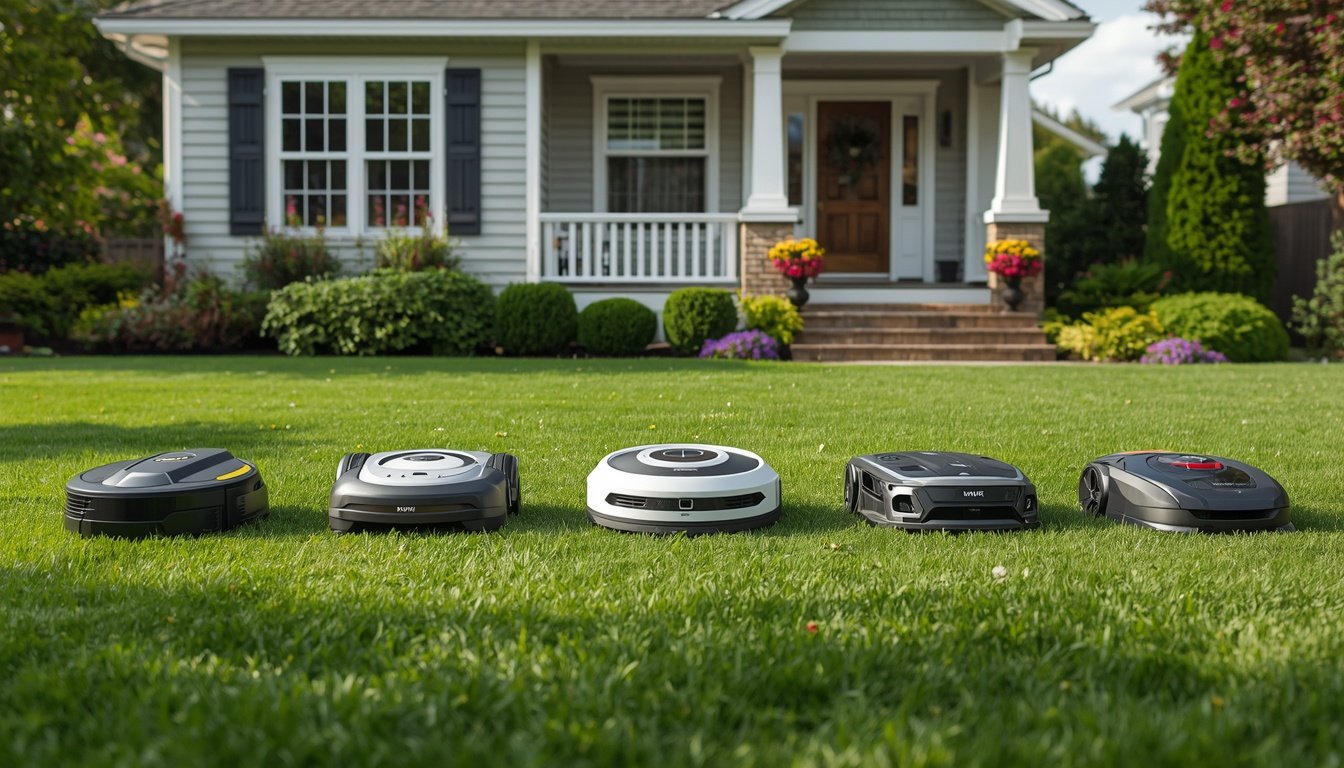
Choosing between wire-free robot mower brands is mostly about matching each brand’s strengths to your lawn, not simply picking the most expensive model. Some brands focus on RTK positioning, some lean into LiDAR or camera-based obstacle detection, and others are strongest for slopes, large lawns, compact yards, or easier setup.
The best brand for one homeowner may be the wrong brand for another. A small flat lawn, a large sloped property, a tree-heavy yard, and a complex multi-zone layout all create different mowing problems, so the right comparison starts with the lawn first and the brand second.
What This Guide Covers
This guide explains how to compare wire-free robot mower brands in a practical way. It looks at navigation technology, lawn size, slope handling, obstacle avoidance, setup style, product range, long-term ownership, and how to decide which brand type fits your yard.
Wire-free mowing is still a developing category, so brand choice matters more than it does with basic garden equipment. A mower is not just a cutting machine. It is a mix of hardware, mapping software, sensors, app control, charging system, positioning technology, and ongoing updates.
If you are still early in your research, start with Best Wire-Free Robot Lawn Mowers. That guide gives a broader buying overview. If your main priority is avoiding a buried cable, use Best Robot Lawn Mower Without Perimeter Wire.
This page is designed as the brand-comparison hub. It does not mean one brand is always best. Instead, it helps you understand what each type of brand or product range is usually trying to solve.
How Brand Comparison Works
Comparing robot mower brands is different from comparing traditional lawn mowers. With a standard push mower, you might focus mostly on engine power, cutting width, build quality, and price. With a wire-free robotic mower, you also need to compare navigation systems, mapping accuracy, app experience, slope capability, sensor design, and support for complex lawn layouts.
A brand that performs well on a simple lawn may not be the best option for a difficult yard. For example, a compact wire-free mower may be ideal for small suburban lawns but underpowered for large properties. A premium AWD mower may be excellent for slopes and rougher ground but unnecessary for a small flat lawn.
Navigation is one of the biggest differences. Some brands use RTK-based positioning, some use LiDAR, some use cameras, and some combine multiple systems. If you are comparing those technologies, read RTK and LiDAR Explained for Robot Lawn Mowers.
Brand comparison should also include the product range. A brand with several models may offer better choices for different lawn sizes, while a smaller emerging brand may have one interesting model but less proven long-term support. Neither is automatically better, but the risk profile is different.
Common Use Cases
For small lawns, the best brand is usually the one that offers easy setup, reliable mapping, sensible pricing, and enough coverage without making the buyer pay for oversized features. A compact mower with good app control may be more useful than a premium model designed for large acreage.
For large lawns, brand comparison should focus on coverage rating, battery capacity, route efficiency, docking reliability, and whether the mower can maintain the full area without constantly falling behind. Larger lawns also make software quality more important because poor navigation wastes more time across a bigger mowing area.
For sloped lawns, traction becomes a major brand differentiator. Some brands offer AWD or stronger wheel systems, which can matter more than small differences in smart features. If your yard has hills, slopes, or uneven terrain, compare models through the lens of traction and stability before looking at extra app features.
For lawns with trees, garden beds, or obstacles, the best brand may be the one with stronger sensing and obstacle avoidance. A tree-heavy yard can create navigation challenges, fallen debris, and more objects for the mower to interpret. In that situation, LiDAR, camera vision, and hybrid systems may become more important.
For complex lawns, the brand needs to handle multiple problems at once. This may include separate zones, narrow passages, slopes, paths, virtual boundaries, no-go areas, and reliable return-to-dock behavior.
Key Factors to Consider
- Navigation system: compare RTK, LiDAR, camera vision, GPS, and hybrid systems based on your lawn layout.
- Lawn size range: check whether the brand offers suitable models for small, medium, large, and complex lawns.
- Slope capability: look at traction, AWD options, wheel design, and real-world terrain suitability.
- Obstacle avoidance: consider how well the mower handles pets, toys, garden beds, trees, lights, and ornaments.
- Setup requirements: check whether the mower needs an RTK base station, guided mapping, app setup, Wi-Fi, or clear sky visibility.
- Support and updates: app quality, firmware updates, warranty support, replacement parts, and accessories can affect long-term ownership.
The most useful comparison is not “which brand is best?” but “which brand is best for this lawn?” That keeps the decision practical and avoids overpaying for features that do not solve your actual problem.
Choosing the Right Option
Start with the lawn size. If your lawn is small, compare compact wire-free models first. A smaller mower can be easier to store, easier to manage, and more affordable. For that route, use Best Wire-Free Robot Mowers for Small Lawns.
If your lawn is large, compare brands with stronger coverage capacity and more capable navigation. Large yards put more pressure on battery life, route planning, docking, and mowing efficiency. A model that is perfectly fine for a compact yard may not be suitable for a large property. For larger properties, read Best Wire-Free Robot Mowers for Large Lawns.
If you are choosing between two of the main brands, use Mammotion vs Segway Navimow. That comparison is useful because those brands often appeal to buyers looking at higher-end wire-free mowing, but they may suit different lawn problems.
If you are mainly comparing product ranges within one brand, Segway Navimow X3 vs i Series can help separate smaller-lawn and premium-lawn use cases.
For buyers focused on navigation technology, compare by system instead of brand. RTK-focused buyers should start with Best RTK Robot Lawn Mowers. Buyers who want LiDAR-focused navigation should use Best LiDAR Robot Lawn Mowers.
Limitations and Considerations
Brand reputation is useful, but it should not replace lawn matching. A well-known brand can still be the wrong choice if the model is undersized, poorly suited to slopes, or not ideal for tree-heavy yards. A newer brand may have exciting features, but long-term support, parts availability, and software maturity may be less proven.
Availability also matters. Some models may be easier to buy in certain countries, while others may appear in reviews before they are widely available. For this site’s buying pages, the priority is products that are actually accessible to homeowners in the target market.
Another limitation is that robot mower features are not always directly comparable. One brand may describe obstacle avoidance differently from another. One model may rely on RTK, another may use LiDAR, and another may combine camera vision with positioning. The words can sound similar, but the real-world performance depends on the complete system.
Do not assume the newest model is automatically the safest choice. Newer models may offer better technology, but they may also have fewer long-term owner reports. Established models may have more user feedback, clearer support information, and more known troubleshooting patterns.
It is also worth watching emerging brands carefully. Some new entrants may bring strong innovation, but it is sensible to check availability, warranty support, app reliability, replacement parts, and real-world reviews before choosing them over more established options. For that side of the market, see Emerging Wire-Free Robot Mower Brands to Watch.