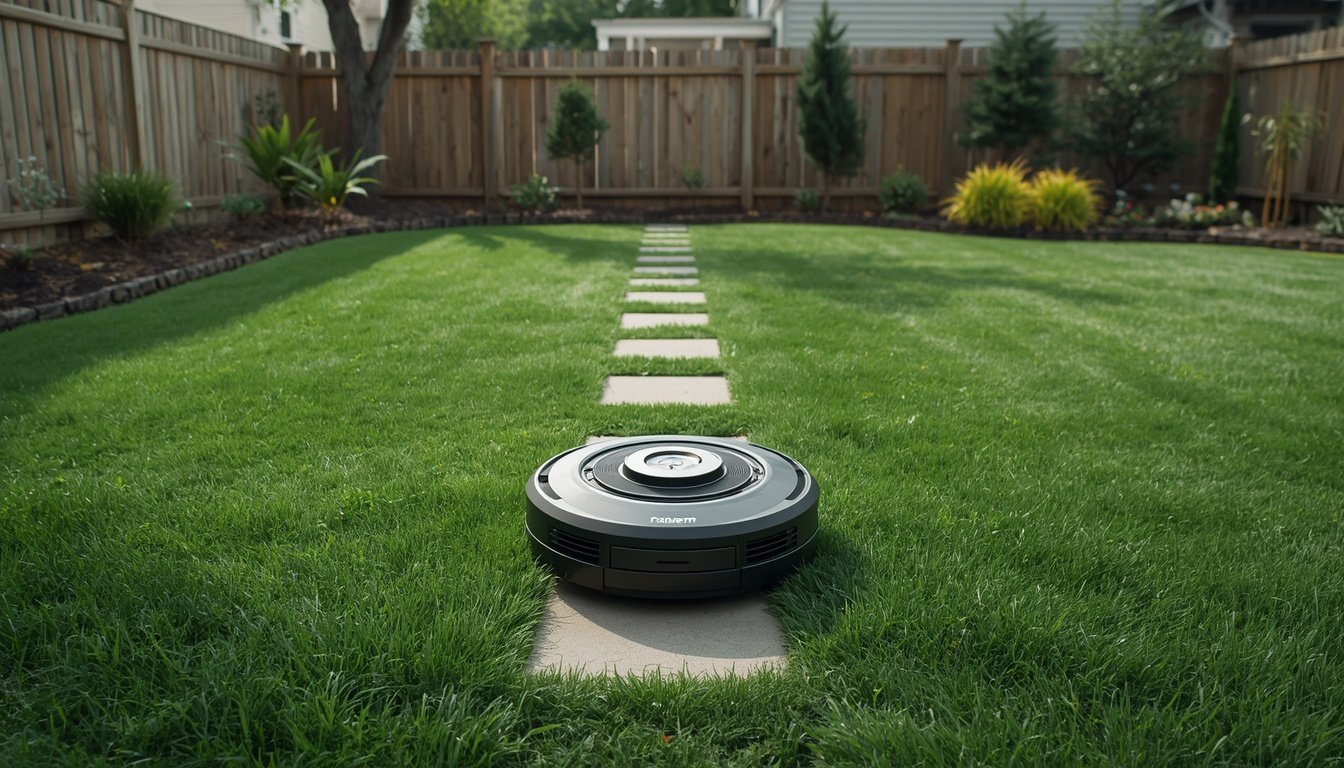
Wire-free robot lawn mowers use virtual boundaries and smart navigation systems, so you’ll see different terms than with traditional models. Understanding terms like RTK, boundary maps, and obstacle detection is crucial when selecting and operating a wire-free mower. To help you start, this article covers the key concepts and jargon you’ll encounter, offering clear explanations. For a more comprehensive overview, you can also check out our wire-free robot lawn mower guide for in-depth coverage.
Virtual Boundary
Virtual boundary is one of the cornerstone terms for wire-free robot lawn mowers. It refers to an invisible perimeter set up digitally, rather than through a physical wire. Instead of installing and burying boundary wire, you create the mowing area by mapping it out through an app or on the mower’s interface. The mower stays within the virtual limits while operating.
With virtual boundaries, you have flexibility. It’s easy to edit or redraw your lawn’s outline whenever landscaping changes. The virtual boundary also allows you to create different mowing zones or disable areas temporarily, such as places with fresh seed or obstacles.
Accurate virtual boundaries depend on advanced technology, such as RTK GPS or LiDAR. These systems track the mower’s location within a few centimeters. If a mower crosses the set boundary, it immediately stops or turns back into the allowed area. Virtual boundaries are central for wire-free models because they replace all the physical installation work required by wired systems. Learning how they function—and how to adjust them—is key to maximizing the mower’s performance and safety.
RTK (Real-Time Kinematic) Positioning
RTK positioning is a high-precision navigation system used by many advanced wire-free robot mowers. Unlike standard GPS, which can have several feet of error, RTK uses a fixed base station and real-time corrections. This allows the mower to know its location within an inch or two. RTK ensures your mower follows virtual boundaries with extreme accuracy, especially on larger lawns.
RTK systems operate by combining satellite signals with data from a local reference point, known as the “base station.” This base station is installed in your yard and communicates with the mower, providing constant updates and corrections. As a result, the mower maintains course even in challenging environments.
RTK is essential for creating precise mowing zones, avoiding overlaps, and reducing missed spots. However, heavy tree cover or tall buildings can sometimes interfere with the RTK signal. Not all wire-free mowers use RTK—some rely solely on visual sensors or other guidance systems. Still, if your lawn is wide or unobstructed, RTK-enabled models usually deliver the best performance and reliability for consistent, thorough coverage.
Common Features and Functions
- Mapping and Area Customization
- Multi-Zone Management
- Obstacle Detection
Mapping and area customization let you define exactly where the robot mower should and shouldn’t mow. With user-friendly apps, you can sketch perimeter lines, create islands the mower will avoid, and update these settings anytime. Multi-zone management allows for independent schedules and patterns in different lawn sections, making it easier to maintain varying grass types or prioritize high-traffic areas. Obstacle detection helps the mower sense and navigate around unexpected items using sensors like LiDAR, ultrasonic, or bump sensors. This technology lets the system avoid garden furniture, toys, and new obstacles automatically, keeping your yard safe and the mower running smoothly.
Each of these features reduces manual lawn care and enhances flexibility compared to older wire-based systems. Using mapping and customization, you won’t need to physically adjust wires or boundaries as your garden changes. Multi-zone control means sections can be addressed with individual maintenance needs or frequencies, helpful for more complex landscapes. Obstacle detection adds convenience and peace of mind, significantly lowering the risk of collisions or missed spots. Combined, these functions form the backbone of a modern wire-free robot mower’s smart capabilities.
Vision and LiDAR Navigation
Besides RTK, many wire-free robot mowers use visual systems to navigate your lawn. Vision-based navigation relies on cameras that recognize objects, patterns, and the edge of grassy areas. The mower’s software interprets these camera feeds, guiding the machine as it stays within assigned boundaries and avoids obstacles. This approach works well in smaller gardens or places where GPS signals might be weak.
LiDAR (Light Detection and Ranging) is another cutting-edge option. LiDAR sensors scan the surroundings using laser beams, building a real-time map of objects, boundaries, and the terrain. This mapping helps the mower understand its position without needing satellites or clear skies.
Vision and LiDAR work together in some premium models for even greater accuracy. They enable the mower to function in challenging environments or places where other guidance methods might struggle. Both systems also improve obstacle avoidance and safety by constantly monitoring the environment and adjusting the mower’s route if a new object appears. These advanced navigation methods are key to the reliability and versatility of today’s top-performing wire-free models.
Mobile App Control and Connectivity
- Remote Start and Scheduling
- Status Monitoring
- Firmware and Feature Updates
Mobile app control has changed how users interact with robot lawn mowers. Remote start and scheduling mean you can set your mower to work from anywhere—whether you’re home or on vacation—directly through an app. You can create or tweak mowing schedules, pause or stop the mower, and send it back to the charging station.
Status monitoring is another valuable benefit. The app lets you track battery life, current location, mower activity, and even receive maintenance reminders or error notifications. This transparency makes lawn care more predictable and helps prevent issues before they happen. Firmware and feature updates keep your robot model current without manual intervention. Manufacturers release software patches through the app, fixing bugs, adding new capabilities, and improving performance over time. Combined, these connectivity features make wire-free robot mowers more versatile than ever and give you maximum flexibility and control in your yard care routine.
Safety, Returns, and Perimeter Security
Safety is a priority with robot mowers, and several terms address this. Lift and tilt sensors stop blade operation if the mower is picked up or tilted, protecting curious kids and pets. Emergency stop buttons let you halt the mower instantly if needed. These measures reduce the risk of accidents and give peace of mind when using autonomous machines in family yards.
Return-to-base (RTB) functions are another important concept. When finished mowing—or when the battery is low—the mower navigates itself back to the charging station. This ensures it doesn’t get stranded or run out of power in the yard. Some models even learn multiple docking points if you have large or segmented lawns.
Perimeter security features protect both your property and the mower. If someone lifts the mower or it leaves your mapped area, theft alarms or tracking functions may activate. Modern wire-free models use location monitoring and, in some cases, geofencing to alert you if your mower leaves the boundaries. These features make it much less likely to lose your mower and allow for quick action if recovery is needed.