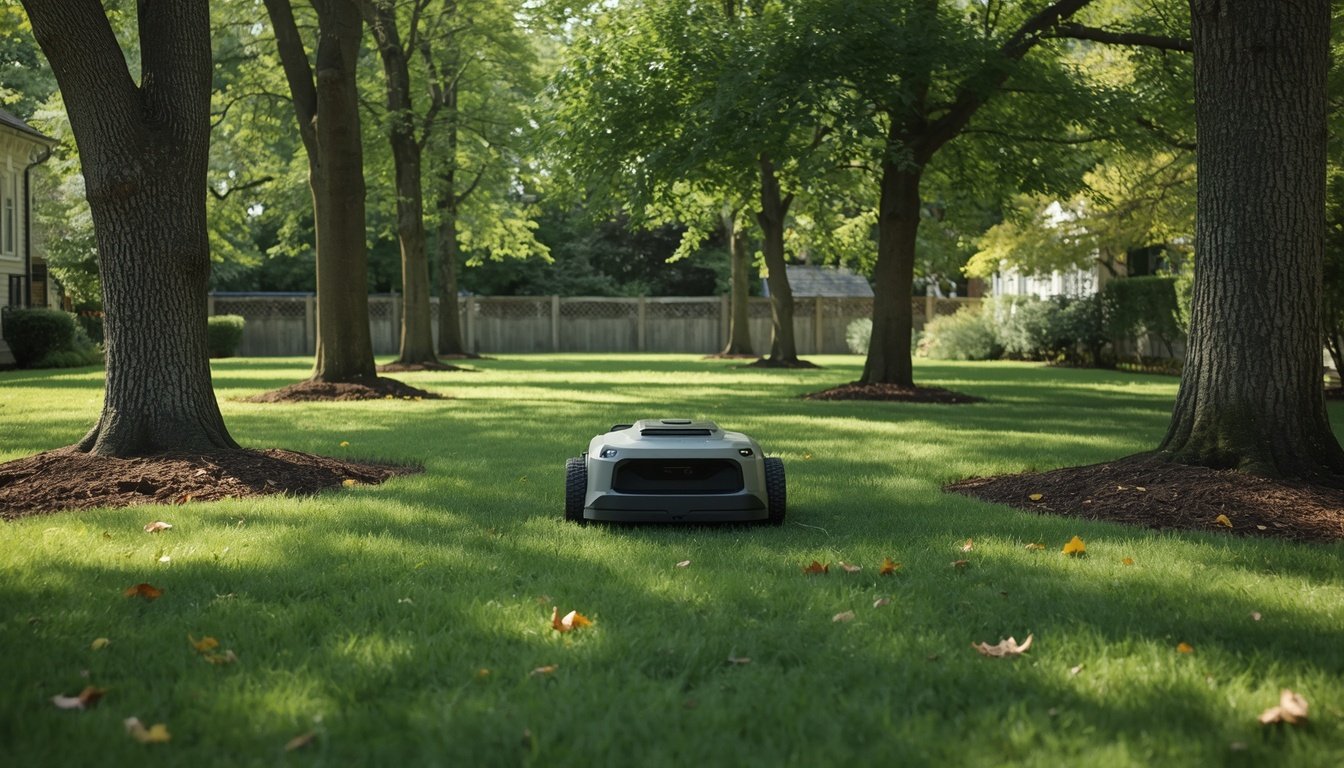
The Segway Navimow i215 LiDAR is the locked product choice for homeowners who need a robot mower for lawns with trees. It is best suited to buyers who want wire-free mowing in yards where tree trunks, shade, roots, leaves, and garden edges can make basic mowing more difficult.
This page is for homeowners with tree-lined backyards, shaded lawn sections, landscaped gardens, or lawns where obstacle awareness matters. The best choice still depends on your tree cover, lawn size, slope, fallen debris, docking location, and whether the mower’s navigation system suits your yard layout.
Quick Picks
- Best overall for lawns with trees: Segway Navimow i215 LiDAR
- Best for tree-heavy yards needing obstacle awareness: Segway Navimow i215 LiDAR
- Best for buyers who want LiDAR-assisted mowing near garden features: Segway Navimow i215 LiDAR
Segway Navimow i215 LiDAR

A LiDAR-assisted wire-free robotic lawn mower option for homeowners with trees, shade, garden edges, and more detailed yard layouts. Check current price
The Segway Navimow i215 LiDAR is the strongest fit for this page because lawns with trees create a different challenge from simple open lawns. A mower working around trees may need to understand trunks, shaded areas, roots, lawn edges, garden beds, and objects that are not always present on a flat open yard.
This product belongs here because it is the locked LiDAR-focused option in the approved product set. LiDAR is useful for buyers who want the mower to sense more of the physical environment around it, rather than relying only on a basic mowing pattern or a simple open-lawn setup.
Best for: homeowners with lawns that include trees, shade, garden borders, or obstacle-heavy mowing areas.
Main advantage: the main advantage is LiDAR-assisted sensing. For lawns with trees, that matters because the mower may need to navigate around fixed objects and lawn features more carefully than it would on a clear open yard.
Main limitation: LiDAR does not remove every tree-related issue. Fallen branches, thick leaves, exposed roots, wet shaded grass, low-hanging limbs, and poor docking routes can still affect mowing performance.
What to Look For
- Tree density: a few open trees are easier for a robot mower than a heavily wooded lawn with trunks, roots, and shaded corners.
- Sensor type: LiDAR can be useful for detecting nearby lawn features, but the mower still needs suitable mapping and setup.
- Fallen debris: leaves, twigs, bark, and small branches can affect cutting quality and may need clearing before regular mowing.
- Signal conditions: tree cover can affect some navigation systems, so check whether your yard has heavy canopy or poor sky visibility.
- Obstacle layout: garden beds, edging, ornaments, tree rings, and exposed roots may need no-go zones or careful boundary setup.
- Grass condition: shaded grass can stay wetter for longer, which may increase slipping, clumping, or stuck points.
Final Recommendation
The Segway Navimow i215 LiDAR is the best overall choice here for homeowners who need a robot mower for lawns with trees. It matches the main intent of the page because it focuses on LiDAR-assisted mowing, which is especially relevant for tree-heavy or obstacle-rich yards.
It is also the best fit for buyers who are less worried about maximum large-lawn capacity and more concerned about how the mower senses the area around trunks, garden edges, and shaded lawn sections.
Avoid this product if your main issue is extreme slope, very rough ground, large acreage, or heavy fallen debris that needs regular manual clearing. In those cases, compare by terrain handling, coverage capacity, and maintenance needs before choosing only for LiDAR.