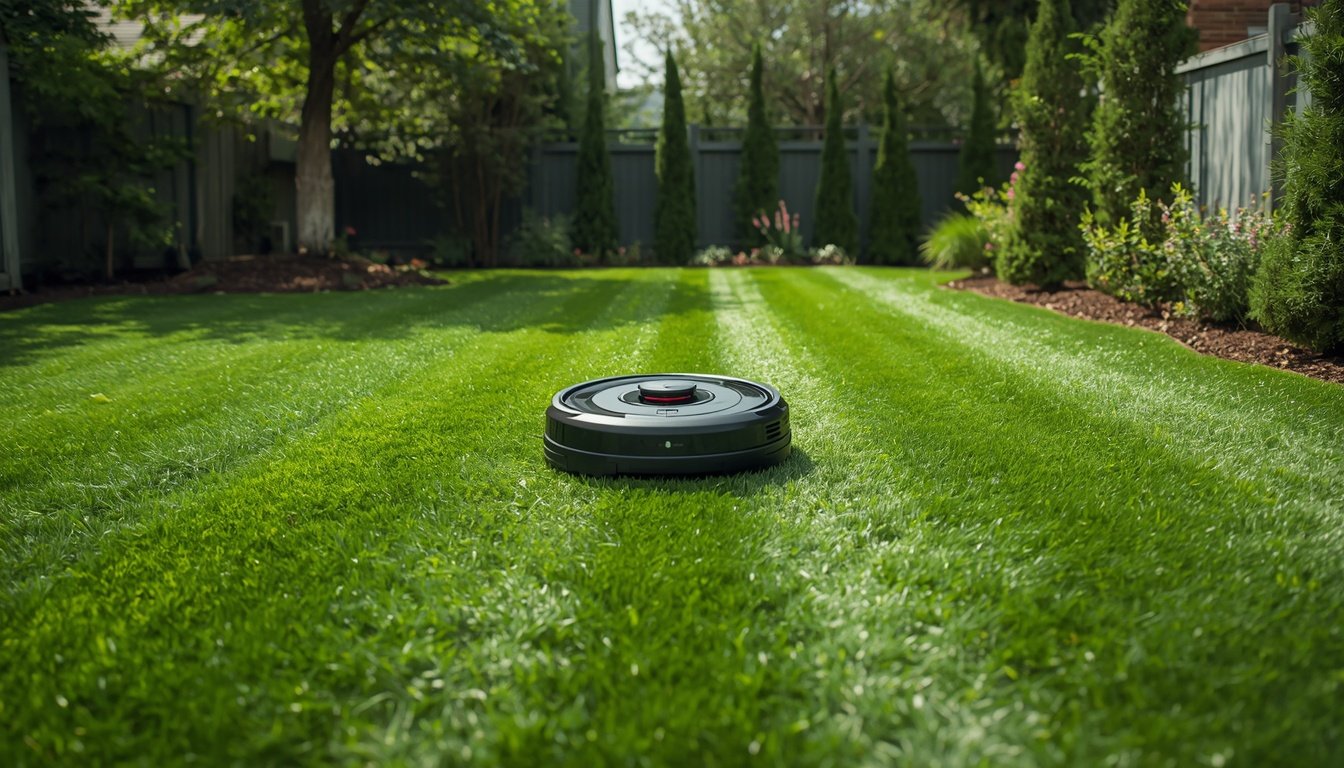
Choosing a wire-free robot mower starts with understanding your lawn, not the mower. The best model for a small flat yard may be completely wrong for a large property with slopes, trees, narrow passages, or separate front and back lawn areas.
Wire-free mowers remove the need for buried perimeter wire, but they still need the right combination of coverage capacity, navigation technology, traction, obstacle handling, and setup features. This guide explains how to match a mower to your real lawn conditions before you compare specific products.
What This Guide Covers
This guide helps you understand the main lawn factors that affect wire-free robot mower performance. It covers lawn size, slope, shape, obstacles, trees, narrow passages, multi-zone layouts, and the difference between a simple open lawn and a complex yard.
The aim is to help you avoid buying a mower based only on price, brand, or advertised coverage. A mower rated for a certain lawn size may still struggle if the property has steep slopes, heavy shade, poor signal areas, wet ground, or awkward transitions between mowing zones.
If you are still learning how these machines operate, start with How Do Wire-Free Robot Mowers Work?. That article explains the basic technology behind wire-free mowing. If your main question is whether you still need perimeter cable, read Do Robot Lawn Mowers Need Boundary Wire?.
Once you understand the basics, the next step is lawn matching. That means choosing a mower based on the actual demands of your property rather than choosing the most advanced model available.
How Lawn Matching Works
Lawn matching means comparing the mower’s capabilities against the physical conditions of your yard. Every robot mower has limits, including maximum coverage area, slope rating, navigation type, battery capacity, wheel traction, obstacle detection, and docking reliability.
The first factor is size. Lawn size ratings usually describe the maximum area a mower is designed to maintain under suitable conditions. A small yard with open grass is much easier to manage than a larger lawn with several separated sections. For a deeper explanation, use Robot Mower Lawn Size Ratings Explained.
The second factor is terrain. Flat lawns are usually easier for most robot mowers, while slopes, dips, uneven patches, and wet areas require better traction and stronger drive systems. If your yard has hills, do not rely only on the coverage rating. You also need to check the slope rating and whether the mower is designed for that type of ground.
The third factor is navigation. Some wire-free mowers rely more heavily on RTK positioning, while others use LiDAR, cameras, GPS, or hybrid navigation. If your lawn has trees or shaded areas, navigation choice becomes more important. The guide RTK and LiDAR Explained for Robot Lawn Mowers can help you understand those differences before choosing a model.
Common Use Cases
A small open lawn is usually the easiest use case. These lawns often need a compact mower with reliable mapping, basic obstacle avoidance, and enough battery capacity to maintain the area regularly. A small-lawn buyer may not need the most expensive premium model.
A large lawn is different. Large properties need more coverage capacity, better route planning, stronger battery performance, and reliable return-to-dock behavior. If the lawn is spread across several zones, the mower also needs good mapping and zone management.
Sloped lawns need special care. A mower may be wire-free and still perform poorly on hills if it lacks traction. Steep grass, damp ground, and uneven surfaces can all cause slipping or stuck points. If slopes are a major issue, read Can Robot Lawn Mowers Handle Slopes?.
Tree-heavy lawns create another common problem. Trees can introduce shade, roots, fallen leaves, twigs, and possible satellite signal issues. Some lawns with trees may benefit from LiDAR, camera vision, or hybrid navigation instead of relying only on a clear sky view.
Complex lawns include narrow passages, garden beds, gates, paths, driveways, slopes, play areas, pets, ornaments, and separate front and back yards. These lawns need more than basic automatic mowing. They need careful setup and a mower with navigation that suits the layout.
Key Factors to Consider
- Lawn size: choose a mower with enough capacity for the actual mowing area, not just the total property size.
- Lawn shape: irregular lawns, curves, corners, and narrow passages need stronger mapping and navigation.
- Slope and traction: hilly yards may need AWD, larger wheels, or higher slope ratings.
- Trees and shade: tree cover may affect signal reliability, obstacle detection, debris handling, and mowing quality.
- Separate zones: front and back yards, driveways, paths, and gates can make setup more complicated.
- Obstacles: toys, pets, garden lights, raised beds, and ornaments all affect the type of obstacle avoidance needed.
These factors should be considered together. For example, a small lawn with lots of obstacles may need a smarter mower than a larger but completely open lawn. A sloped lawn with no trees creates a different challenge from a flat lawn with heavy shade and narrow access points.
Choosing the Right Option
Start by walking around your lawn and listing the difficult areas. Look for slopes, soft patches, tight passages, garden beds, trees, stepping stones, driveways, gates, and areas where a mower may need to turn or dock. These details are often more important than the headline product claims.
For a small and simple lawn, you can usually prioritise value, compact size, easy setup, and reliable app control. For this type of yard, a use-case buying guide such as Best Wire-Free Robot Mowers for Small Lawns is more useful than a broad premium roundup.
For a larger lawn, prioritise coverage rating, battery capacity, route efficiency, and multi-zone handling. Large lawns often justify a more capable mower because the time saved is greater and the mower has more ground to manage. For that scenario, use Best Wire-Free Robot Mowers for Large Lawns.
For a sloped or uneven yard, traction should move to the top of the list. Look for strong wheel design, AWD where needed, and a slope rating that comfortably exceeds your real conditions. If the lawn is bumpy or rough, use Best Robot Lawn Mowers for Uneven Ground.
For tree-heavy or complex yards, navigation and obstacle handling become more important. A mower that works beautifully on a clear open lawn may struggle in a shaded yard with trunks, roots, fallen leaves, and irregular boundaries. If trees are a major feature, use Best Robot Mowers for Lawns With Trees.
Limitations and Considerations
No robot mower suits every lawn. Even the best wire-free models have limits. They may still need careful mapping, good charging station placement, firmware updates, occasional blade replacement, and manual trimming around some edges.
Advertised coverage can also be optimistic if the lawn is difficult. Slopes, tight corners, wet grass, obstacles, and separated zones can all increase the work the mower has to do. If your lawn is near the upper limit of a mower’s rated capacity, it may be smarter to choose the next size up.
Wire-free technology also does not remove every setup issue. Some mowers need a base station with clear sky view, while others need strong app mapping or sensor visibility. A poor setup can cause missed areas, signal problems, boundary errors, or repeated docking failures.
It is also realistic to expect some manual work. Robot mowers are best at frequent lawn maintenance, not full garden care. They may not remove heavy debris, collect clippings, trim perfectly against every edge, or handle badly overgrown grass. For many homeowners, the mower reduces most of the weekly mowing burden but does not eliminate every outdoor task.